At a Glance
- Sector
- Stone / quarry
- Challenge
- Spreadsheet escape, Growth
- Outcome
- Sales pipeline became easier to manage.
A quarry and stone manufacturing business replaced fragile manual tracking after rapid growth.
Working through the spreadsheet escape and growth challenges behind Stamford Stone's CRM, CRM Insights connected the system to the business process, data quality, adoption and reporting decisions around it.


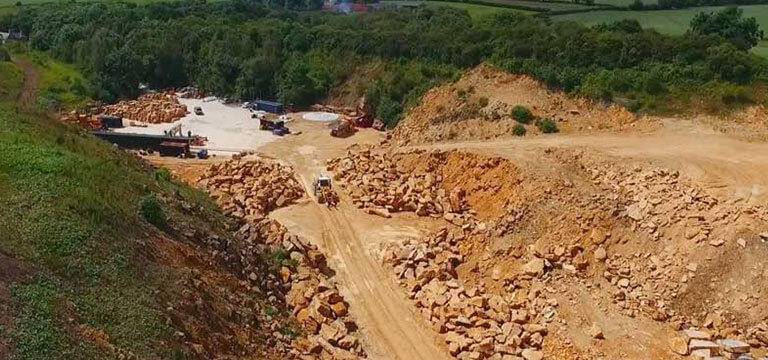
Stamford Stone is a stone manufacturing plant and quarry operator
To overcome reliance upon a single sector, the leadership team had set about diversifying the business. Rapid growth ensued, with the volume of shipped product quadrupling, and turnover increasing from £1.5m to £7m.
However, much of this growth was still being managed by a core back-office team that was reliant upon undocumented processes and sticky notes.
“We wanted the business to continue to grow but got to a point where we knew we were losing money. We were losing sales leads because we didn’t have the capacity to keep on top of them. We were losing timescale in production and having to extend lead times which lost us some clients. But it wasn’t the production facilities – they were fine – it was the administration.”
Laura Green, Director

With a fourfold increase in staff, and tenfold increase in clients, the management team found it difficult to maintain control. However, a solution wasn’t obvious.
“We went out to different sales coaches, we undertook team-building courses, but it kept coming back to a lack of communication. Only we didn’t know what would resolve it.”
Laura Green, Director
With CRM suggested as a solution, Stamford Stone got in touch with CRM Insights. There was, however, still a lingering doubt. Stamford Stone wanted something that would fit with it, rather than it having to fit with a software product.
CRM Insights determined Workbooks to be a good fit.
Next was to define the detailed requirements by mapping out the business processes. This covered the entire business cycle from initial enquiry, through design and estimation, sales order processing, production, and invoicing. An activity that Stamford Stone initially found daunting:
“Everybody is so busy that it’s difficult to get people to give up their time for the greater good. But you have to go through it. It was a really simple exercise that was as useful to us as the CRM product itself! We identified double-handling, dual-processing, bottlenecks and knowledge gaps.”
Laura Green, Director
Having implemented Workbooks at Stamford Stone, the business is in a very different place:
“The whole thing feels calmer. I now have a much better understanding of the business. For the team, it’s improved the processes and internal communications between departments. The monitoring of leads has helped the Sales team an awful lot. It’s created a healthier work environment for everyone. And it‘s made it a more enjoyable business to run.”
Laura Green, Director
CRM Insights has provided support beyond Workbooks, including:
- Integration of Xero following a migration from Sage
- Implementation of Stripe as a card payment solution
- Implementation of Communigator as an email marketing solution
As Stamford Stone continues to grow, CRM Insights is there alongside as a supporting partner:
“The business is ever evolving, the targets constantly moving. Workbooks can grow with us as different aspects of the business change. There’s no danger of outgrowing the system, and CRM Insights is there alongside in an advisory capacity.”
Laura Green, Director
If your business is experiencing similar growth challenges?
Then click the button below to schedule a free consultation with one of our CRM experts.